Croydon
From airport history to tramlines and tower blocks, Croydon moves still live or die by planning.
Areas covered in This Borough

Useful Information on
Croydon
Man and Van Services in Croydon, London
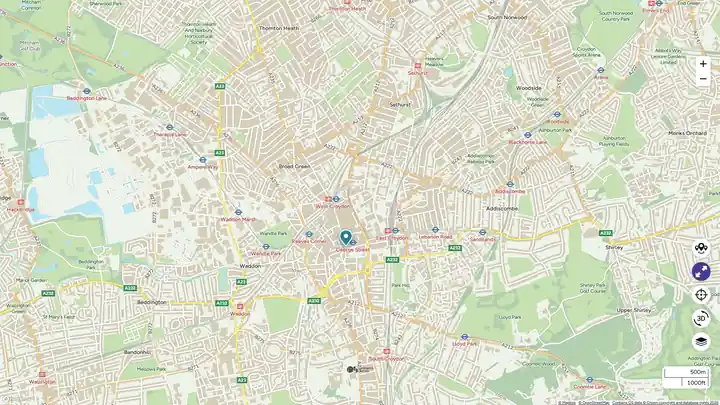
Croydon splits more sharply than many London boroughs. Central Croydon, West Croydon, Thornton Heath and parts of South Norwood are denser, more access-sensitive and more shaped by tram, bus and station pressure. Purley, Sanderstead, Coulsdon, Shirley and parts of South Croydon are usually more suburban, with more drive access and larger residential roads, but the distances are longer and some routes are hillier. VanHub UK suits a borough like this because the hard part is often working out whether the address behaves like a town-centre job or a suburban one before the van even arrives. (Croydon Council)
That difference affects timing straight away. In central Croydon, the local transport evidence points to congestion and servicing pressure around George Street, Wellesley Road, West Croydon and the tram network, including loading conflicts west of Wellesley Road and poor access conditions around key stations. In the outer south and east of the borough, the work is often easier at the kerbside but slower overall because journeys are longer and jobs are more spread out. (Croydon Council)
Major Areas and Property Types in Croydon
Croydon’s strongest local signal is the divide between the Opportunity Area and the more suburban outer borough. The Croydon Local Plan identifies the Croydon Opportunity Area as the main focus for significant growth and renewal and names three transformation areas: Purley Way, the Brighton Main Line and East Croydon Transformation Corridor, and the North End Quarter. The same plan also states there are no suburban intensification areas, which is useful because it shows the borough is not being treated as one blanket growth zone. In practice, that means central and inner Croydon are much more likely to produce flat-based, mixed-use and access-sensitive jobs than the outer southern districts. (Croydon Council)
That built form matters. Central Croydon, East Croydon, West Croydon and parts of South Norwood produce the kind of work that goes with apartment blocks, estates, mixed-use buildings and denser residential streets. By contrast, Purley, Sanderstead, Coulsdon and Shirley more often produce full house moves, driveway loading, garage and loft clearances, and larger domestic jobs. The borough’s own tall-buildings evidence also shows that height is not confined only to the centre. In New Addington, the study identifies an eight-storey residential tower adjacent to New Addington Tram Stop and another eight-storey tower at the far extent of the central area, with an 11-storey block on Chertsey Crescent nearby. That is a strong signal that some outer Croydon jobs are still very much block-access jobs. (Croydon Council)
A second strong local anchor is Regina Road in South Norwood. Croydon says the redevelopment will replace the existing estate blocks with up to 340 new homes, including at least 215 Council homes, and its timeline confirms demolition and preparatory works began in 2025. That supports a very real Croydon job type: estate decants, regeneration-related removals, contractor traffic, compact flat moves and jobs where the road access may be manageable but the site logistics still slow everything down. (Newsroom)
Road Access and Driving Conditions in Croydon
Croydon’s road pattern is one of the clearest operational signals in the borough. Its transport evidence says the main strategic road network includes the A22, A23 and A232, with other important routes including the A235, A236, A212 and A222. That matters because many Croydon jobs are affected by arterial-road traffic rather than just local residential parking. A move from Purley to East Croydon, or from Shirley into central Croydon, can look short in London terms but still be shaped by congestion on those corridors. (Croydon Council)
The tram network is the bigger Croydon-specific factor. Croydon’s own transport work points to congestion on the central Croydon loop, identifies delays caused by tram priority at Addiscombe Road/Chepstow Road, and says loading restrictions on George Street west of Wellesley Road are often violated, causing delays to trams. It also says access to West Croydon station is affected by buses and illegal parking. That is exactly the kind of local signal that changes a van job on the day. A realistic Croydon scenario is a small collection near George Street where the item count is modest, but the real difficulty is legal stopping, tram crossings and keeping the job moving without blocking the corridor. (Croydon Council)
The other side of the borough behaves differently. In Purley, Coulsdon and Sanderstead, the pressure is often not tram priority or dense loading conflict but distance, gradients and the fact that addresses are more spread out. Those areas can be easier for a larger van to access, but they are less stackable in a day because the driving time between jobs is longer. That is a classic Croydon split and one of the reasons local knowledge matters so much here. (Croydon Council)
Types of Van Jobs in Croydon
Croydon supports a broad mix of work. In the denser parts of the borough, the natural jobs are flat moves, part moves, single-item collections, storage runs, estate clearances and mixed-use deliveries. Around central Croydon and the Opportunity Area, the growth focus also supports office-related transport, furniture deliveries into newer developments, and contractor or fit-out jobs tied to regeneration. The Local Plan’s growth pattern makes that clear because so much of the borough’s development pressure is concentrated in the central Opportunity Area and named transformation corridors. (Croydon Council)
Outer Croydon adds a different job mix. Purley, Sanderstead, Shirley and Coulsdon more naturally produce full house moves, white-goods deliveries, garage and loft clearances, garden furniture transport and larger family relocations. New Addington adds another layer, because the tower-block and estate pattern means even some outer-district jobs still involve lifts, communal access and longer internal carries. VanHub UK works in Croydon because the borough needs both domestic suburban coverage and drivers who are comfortable with denser estate and apartment work. (Croydon Council)
Areas Covered Around Croydon
Croydon sits in a strong cross-borough position. Its strategic network and station system naturally pull work north toward Lambeth and Southwark-facing routes, east toward Bromley and Lewisham corridors, and west toward Sutton and Merton. The Brighton Main Line and East Croydon growth focus reinforce that, because they make Croydon a borough where jobs regularly flow out of the centre rather than staying tightly internal. (Croydon Council)
Why Local Drivers Matter in Croydon
Croydon is a borough where a local driver usually has an edge quickly. They are more likely to know which jobs are really central Croydon access jobs in disguise, where tram corridors and station pressure slow things down, and which addresses in outer Croydon are genuinely easier because of drive access and lower kerbside pressure. They are also more likely to recognise that places like Regina Road or New Addington can still behave like estate and tower-block jobs even though they are outside the centre. That is why VanHub UK makes sense here. It helps match the job to the borough’s real operating conditions rather than a generic “south London” assumption. (Newsroom)
Opportunities for Van Drivers in Croydon
For drivers, Croydon can be strong because the work is layered. There is central-density work, estate and regeneration work, suburban house work, and commercial movement around the Opportunity Area, East Croydon and Purley Way. The challenge is that weak planning gets punished fast. A driver who prices central Croydon like an easy short-haul suburban borough centre will lose time in tram-sensitive roads, station congestion and controlled loading conditions. A driver who treats the whole borough like tower-block territory will overcomplicate the easier outer-house jobs. Drivers who understand the split tend to do better because they can quote more accurately and plan their day more realistically. (Croydon Council)
Find a Driver in Croydon
If you need a move, delivery, collection or clearance in Croydon, the useful question is not just what the postcode is. It is whether the job sits in a tram-sensitive central corridor, a station-pressure road, an estate block or a more spacious suburban street. That is what usually decides whether the booking is smooth or stressful. VanHub UK helps customers browse local drivers and request quotes from people who understand those Croydon-specific differences from the start. (Croydon Council)